
The government also appointed Dr Vinod Paul, a pediatrician at the AIIMS, as a member of the NITI Aayog

For existing technologies, unless appropriate financing is available, deployment at scale is difficult.

There are various estimates of India's debt to GDP ratio, but the consensus is that that it would be over 80 per cent at the end of the current fiscal year.

The Indian startup ecosystem has lauded the inclusion of startups in the New Delhi Leaders' Declaration for the first time ever in the history of G20. Industry stakeholders say that the move will lead to easier access to capital, reduce regulatory hurdles, and may revive funding activity. The Declaration, through the Startup20 initiative, recognised startups as "natural engines of growth" and key to socio-economic transformation by driving innovation and creating employment.
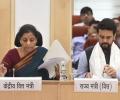
If the protected growth in GST revenue is reduced to 10 per cent, the Centre would save more than Rs 25,000 crore in 2020-21 if none of the states show any revenue growth. This would nearly amount to 0.1 per cent of the gross fiscal deficit and help the government in avoiding fiscal slippage to some extent in subsequent years.
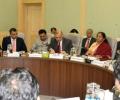
At a pre-Budget meeting, the FM was asked to ensure that NBFCs come out of the liquidity crisis they are facing with the help of RBI. They also spoke about the futility of trying to achieve a 3 per cent fiscal deficit target over the medium term.

The Appointments Committee of Cabinet has named Ravneet Kaur, a Punjab cadre IAS officer of 1988 batch, as chairperson of the Competition Commission of India (CCI). Kaur will hold the post for five years or until attaining the age of 65. She is the second woman to serve in an 'economic regulator' role after Madhabi Puri Buch, who was appointed chairperson of the Securities and Exchange Board of India last year and the first woman to head the country's chief national competition regulator.

'The focus needs to shift towards the ability to collect payments, particularly in tier-3 to tier-4 areas where acceptance is still lacking.'

Indian society may be more advanced than we think it is, notes Ajit Balakrishnan.
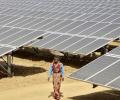
The push given to rooftop solar installation in the Interim Budget ties in with its high rate of adoption in Tier-II and -III cities of India. If original equipment manufacturers (OEMs) in the automobile industry, government, and the solar sector are to be believed, in cities of Rajasthan, Gujarat, and Kerala, 45-50 per cent of electric-vehicle (EV) users are employing rooftop power to charge their vehicles. This is compared to the national average of 25 per cent, say industry sources.

A long crisis with a lack of sound short-term, long-term actions can result in sluggish growth in India, similar to that in Japan.
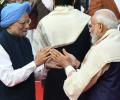
False and acrimonious debates such as Modi versus Manmohan might allow for victories that are political and partisan. But the real loser is the nation, India and Bharat, notes Arvind Subramanian, former chief economic advisor to the Modi government in its first term.
The fall in investment rate is not surprising. But putting it together with rising share of wages in GVA, it shows that the focus is more on productivity, rather than adding new capacity, says Pronab Sen, former chief statistician of India.

India's macroeconomic situation is certainly better than what it was a year ago, eminent economist Pinaki Chakraborty said on Monday, while expressing hope that the country will be back on the path of economic growth if there is no major third wave of the COVID-19 pandemic. In an interview with PTI, Chakraborty, who is the director of the National Institute of Public Finance and Policy (NIPFP), said that inflation may remain at an elevated level as there was a significant fiscal and monetary expansion in the last 18 months. "The current macroeconomic situation is certainly much better than what it was one year back. We are seeing recovery in most sectors," he said. Chakraborty noted that COVID-19 vaccination has been going on at a very fast rate in India.

India's inclusion in JP Morgan's bond index can channel billions of dollars into India. How will the government securities market handle it?
Data on the new series given by a panel on real sector statistics shows that GDP grew by 10.23 per cent in 2007-08 and 10.78 per cent in 2010-11. There are some years for which the new figures show a deceleration in growth as well. The new series has 2011-12 as the base year while the earlier series had 2004-05 and 1993-94.

The implementation of their recommendations means that an adequate apparatus to change this is at the disposal of the government.

Over 15 years, with seven per cent growth, the Indian economy will be three times bigger.

Any additional effort to assuage the growing worldwide hunger for infrastructure funding is more than welcome, says Barun Roy.

Measures that quickly boost demand and increase employment are needed to push up growth. Moreover, without announcing new planss, the government should strengthen schemes such as PM KISAN, MNREGA and programmes to build rural roads.

Since the inception of the code, the threat of insolvency has brought many debtors in line

Without bringing sound governance and technical capabilities into the RBI's work, injecting new money sets the stage for a next wave of bad behaviour by banks, warns Ajay Shah.

GST reform has been hanging fire since 2006-07.
'The Budget numbers presented severely underestimate the magnitude of the unstated fiscal crisis that we went through in 2018-2019, which cannot be conceivably be fully reversed in 2019-2020,' points out Rathin Roy, director, National Institute of Public Finance and Policy.

The Centre has to bear the maximum burden of borrowing NSSF loans to the tune of Rs 1 lakh crore.

Indian cities need $840 bn investment over 15 yrs, says World Bank report.

'The Reserve Bank's independence has remained a work in progress, an enduring challenge that the nation has been grappling with on an ongoing basis,' says RBI Deputy Governor Dr Viral Acharya.

Modi attended the 20th ASEAN-India Summit in Jakarta. Secretary-General of ASEAN Dr Kao Kim Hourn also attended the summit.

The Rajya Sabha on Wednesday approved the biggest tax reform since Independence.

The department of investment and public asset management (Dipam) can also seek in-principle approval from the Cabinet Committee on Economic Affairs (CCEA) for strategic divestment of PSUs on a case-to-case basis considering investor appetite and sectoral trends.

'Concerns about India's future are hampering private investment.' 'If the private sector sees strategy, teams and execution on these issues, this will inspire confidence in India.' 'This should be our main strategy for 2017,' says Ajay Shah.

The Budget is remarkably coherent.

In its essence, GST is a national level system of value added taxation of goods and services, says Shankar Acharya.
Modi's BJP has promised more revdis or freebies for these assembly elections than ever before, points out N Sathiya Moorthy.

The result is a big blow to the military establishment, revealing the limits of 'political engineering'. It reflected the anger of the electorate, especially its younger voters, who have spoken decisively against the persistent harassment and victimisation of Imran Khan's political party, asserts Rana Banerji, who headed the Pakistan desk at RA&W.
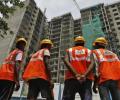
Modi govt must bring about reforms to kick-start big-ticket infra projects.
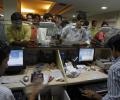
Control over PSU banks is what is allowing the government to drive this scheme.

State Higher and Technical Education Minister Chandrakant Patil also said that the government will introduce four-year degree courses from June 2023 as mandated under the National Education Policy and the universities will have to implement the decision.

The National Democratic Alliance won 64 seats.

Make in India needs policy support for access to markets.
